

A Finishable Runbook Makes Every Setup Step Verifiable
An engineering onboarding runbook is an ordered set of setup instructions, access requests, and checks that takes a new hire from an unconfigured workstation to a verified local development workflow. Most internal wikis fail this basic definition. They treat onboarding as an administrative scavenger hunt where signing acceptable-use policies and bookmarking a repository count as completion. Meanwhile, new engineers sit blocked on day four because they cannot run a single local test suite without pairing with a senior developer to untangle broken developer tooling.
Deterministic Onboarding Core
To build an onboarding runbook engineers can actually finish: capture actual blockers during live execution, order instructions strictly by technical prerequisites, verify each stage with deterministic checks, and assign clear maintenance ownership inside the codebase.
Finishing an onboarding sequence requires reaching an explicit technical outcome. In a healthy engineering culture, the verification target is executing the repository's documented local verification command from a clean shell with an exit code of 0. When instructions are accurate and prerequisites are mapped properly, the initial baseline expectation is completing workstation environment setup and local build verification within the first 4 to 6 working hours once hardware is in hand. Anything longer indicates undocumented software architecture dependencies disguised as tribal knowledge.
Shadow a New Hire and Record Every Unwritten Detour
When an onboarding buddy screen-shares and drives the terminal the second an error appears, the runbook stays broken. The buddy supplies missing flags from memory, bypasses broken scripts, and leaves the documentation untouched for the next victim.
Fix this by running a silent observation session. A new hire follows the existing instructions while a teammate records friction without immediately narrating the missing steps. Schedule two 90-minute shadowing blocks across the hire's first two days, separated by time for asynchronous access approvals. During these blocks, enforce a wait threshold before observer intervention: allow 3 to 5 minutes of active troubleshooting on a single undocumented failure before stepping in. Silence forces undocumented tribal knowledge into the open.
Do not trust memory during the session. Split each shadowed onboarding blocker into four distinct log columns: the attempted task, the exact stopping point, the missing prerequisite or explanation, and the remedial action that restored momentum.
- Undocumented runtime version: The hire attempts to build the binary; compilation halts on a syntax error; the repository lacks a version declaration file for the local compiler; the observer supplies the exact legacy version flag needed.
- Unclear repository location: The hire searches the version control host for the core service; three similarly named forks appear; the runbook names the service conceptually without a canonical URL; the observer pastes the exact clone URI.
- Missing environment variable: The local test runner crashes on initialization; a stack trace points to an uninitialized configuration key; the sample environment file omits a mandatory local secret; the observer exports a dummy token in the shell profile.
- Orphaned access request: The hire needs read tokens for an internal package registry; the instruction says to request access without naming a ticketing queue or group; progress stops completely until the observer pings an infrastructure channel manually.
Put Accounts and Approvals Before the Commands That Need Them
We initially structured our onboarding guide by functional department—IT tasks first, security second, engineering third—before abandoning that layout when new hires spent their entire first morning waiting on an identity ticket before even reading what system packages they could install locally without remote permissions. Organizing a runbook around team boundaries or the chronology of old chat threads guarantees idle time.
Convert the observation log into a dependency-ordered sequence. Typical approval latency for internal identity management or read/write repository access spans 2 to 18 business hours depending on timezone alignment. If an engineer discovers they need an access token at step twelve of a local build, their day is over. Separate requests that must start immediately from work blocked on approval so the hire can make progress while waiting.
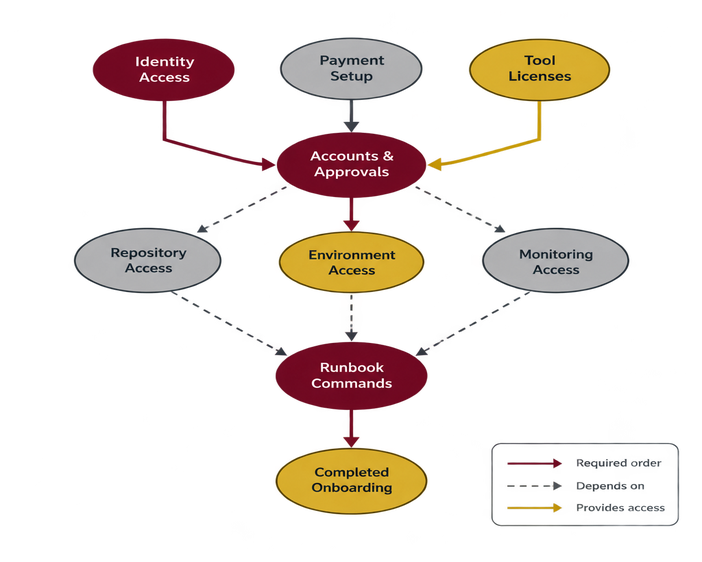
Immediately after filing remote access tickets, route the engineer into the parallelizable local setup window: 45 to 75 minutes of package manager bootstrapping, compiler installation, and SSH key generation that requires zero external permissions. Once the asynchronous approvals clear, the runbook follows a strict dependency chain:
- Request repository and internal artifact registry access.
- Execute local workstation bootstrapping while awaiting approval tickets.
- Verify remote access permissions via authenticated CLI check.
- Obtain the project source code.
- Install its declared dependencies.
- Configure local environment settings.
- Run the documented local verification check.
Give Each Setup Step an Action, a Check, and a Recovery Path
Why do engineers still fail to build a project when the exact installation commands are written down? Usually, loose markdown paragraphs omit context. Reviewing onboarding post-mortems regularly reveals engineers running installation commands in the wrong subdirectory or ignoring non-fatal warning flags that later break the local test runner.
Replace conversational prose with a strict six-field schema for every stage of the setup. The required step metadata fields are Prerequisite, Action, Expected Result, Verification, Recovery, and Responsible Role. Precision means stating the exact working directory, identifying where the required runtime version is declared in the repository, and describing the command's intended result. Also draw a hard editorial line between undocumented human routing ("ask Dave in Slack") and an executable escalation path that names a maintained support destination alongside the failed step, checks already attempted, and sanitized terminal output.
Illustrative Example: Step 05 — Install Declared Project Dependencies
Prerequisite:     Repository cloned to <local-workspace-path>/<repo-name>.
                  Active runtime matches the version declared in <repo-root>/<runtime-version-file>.
Action:           Change working directory to <local-workspace-path>/<repo-name> and execute:
                  <declared-package-manager-install-command>
Expected Result:  All locked packages download and compile into the local dependency directory
                  without fatal errors or peer incompatibility halts.
Verification:     Run <package-manager-verify-command> && echo $?
                  Terminal must output 0.
Recovery:         If registry authentication fails or native extensions fail to compile,
                  clear the local cache using <cache-clean-command> and verify token scope.
                  If unresolved, escalate to Responsible Role.
Responsible Role: <platform-tooling-support-channel-or-queue>
                  Escalation payload must include: Step ID (Step 05), output of
                  <runtime-version-command>, and the last 20 to 40 lines of sanitized terminal stderr.
Test the Written Path Without Supplying the Missing Instructions
Writing the six-field schema is half the work. Validating the updated documentation on a maintainer's primary laptop gives false confidence because cached credentials, global binaries, and residual dotfile configurations mask missing steps. A runbook is only verified when tested on fresh virtual machines or newly imaged hardware by an engineer unfamiliar with the specific service setup.
Before starting the test, execute a pre-test audit scope: check the test environment for pre-existing SSH keys, global runtime managers, cached package registries, and inherited shell profile exports. Record any prerequisites already present on the test machine so a working setup is not mistaken for a complete written path. This dry-run verification method loses accuracy in environments that rely on hardware-bound biometric tokens or MDM profiles that cannot be provisioned inside an isolated test account or temporary virtual machine; for those specific steps, test directly on spare physical fleet hardware.
Schedule the dry-run verification window as a 2-to-3-hour timeboxed session executed by an engineer from an adjacent team or inside a clean disposable user profile. An observer monitors the session without coaching, tracking every manual intervention, unexplained choice, broken reference, and verification step that requires subjective human interpretation. If the tester has to guess which flag to pass, the step fails verification and returns to editing.
Assign Runbook Ownership Before the Next Hire Arrives
Documentation rots the moment build scripts evolve. Storing an onboarding guide in an external corporate wiki leads to immediate drift whenever system dependencies change. Keep the runbook directly inside the primary repository near the workflow it documents, and make its code review route explicit.
Assign an accountable maintainer to the runbook as a whole, alongside responsible roles for distinct setup areas including identity access, workstation requirements, and project execution. When the runbook lives in version control, reviewers can block pull requests that alter local environment requirements without updating the setup docs. Trigger mandatory runbook updates whenever a pull request introduces a changed runtime requirement, a new access-request destination, a replaced setup command, or whenever a blocker is discovered during live onboarding.
Enforce maintenance discipline by placing a freshness header at the top of the runbook file showing the last verified date (YYYY-MM-DD), the workstation OS version, and the exact 7-character Git commit SHA tested. Even if team growth pauses, enforce a maximum staleness threshold before mandatory re-verification: 60 to 90 calendar days when no new hires have traversed the document.









Your Thoughts
Share your thoughts.
Join the Discussion